From algorithmic neutrality to pedagogical judgment
generative artificial intelligence biases and their impacts on assessment fairness in Higher Education
DOI:
https://doi.org/10.47519/IJAIET.v1i00.2Keywords:
Generative Artificial Intelligence, Algorithmic bias, Assessment fairness, Pedagogical judgment, Higher educationAbstract
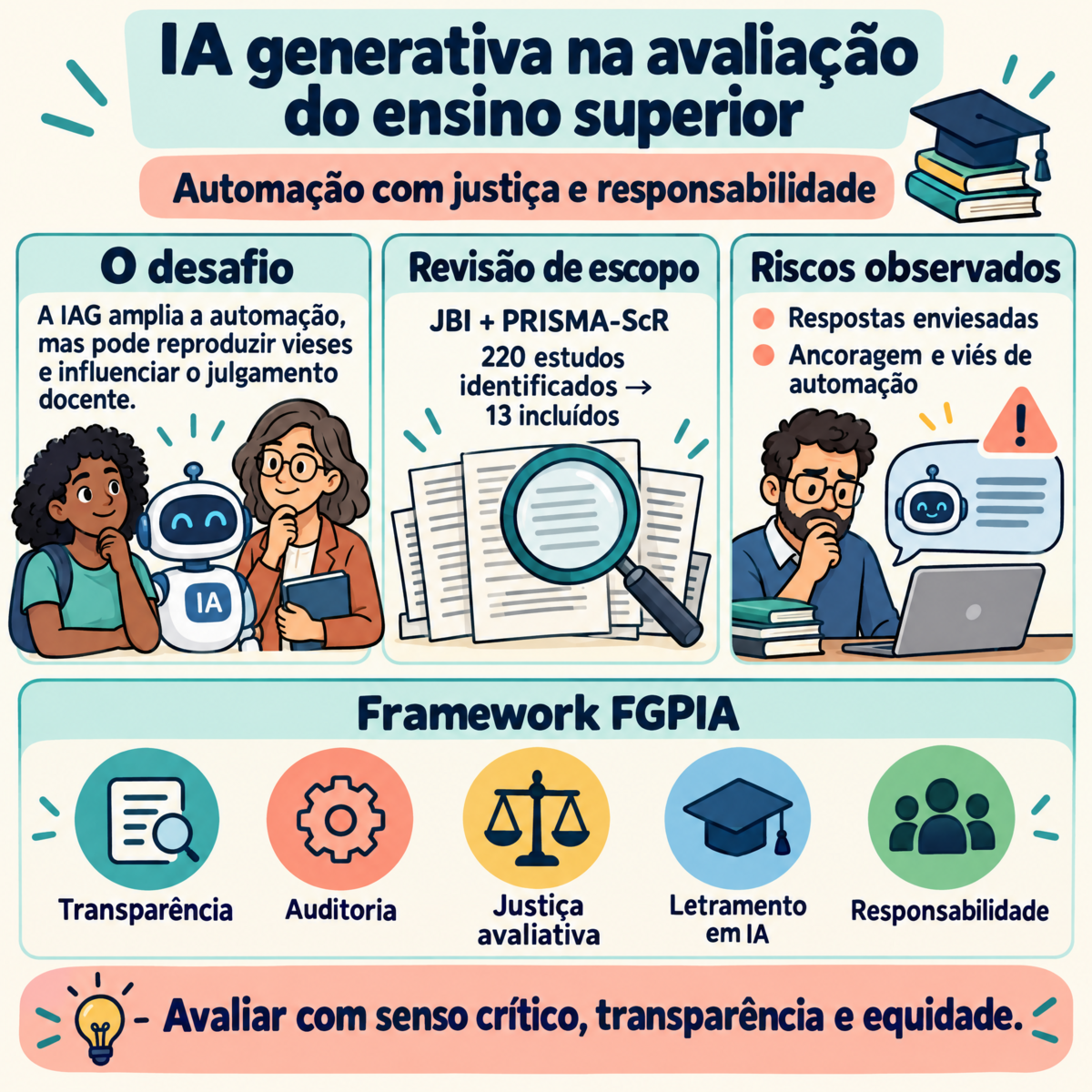
The integration of generative artificial intelligence (GenAI) into assessment in higher education expands opportunities for automation but raises concerns about algorithmic bias and fairness in assessment. This study aimed to map and analyze evidence on biases in GenAI and their influence on educators’ pedagogical judgment, identifying implications for assessment fairness and pedagogical governance. A scoping review was conducted following the Joanna Briggs Institute (JBI) methodology and PRISMA-ScR guidelines. Searches were performed in Scopus, Web of Science, ERIC, ACM Digital Library, Google Scholar, and OpenAlex, supplemented by backward reference searching. Of the 220 studies identified, 13 were included in the synthesis. The findings indicate that GenAI can generate biased outputs and influence educators’ decisions through anchoring and automation bias. As a conceptual contribution, the study proposes the Artificial Intelligence Pedagogical Governance Framework (AIPGF), grounded in transparency, auditing, assessment fairness, AI literacy, and accountability, to guide more critical, transparent, responsible, and equitable assessment practices.
Downloads
References
Alfaleh, M. (2026). Sustainable AI-driven assessment in higher education: A systematic review of fairness, transparency, pedagogical innovation, and governance. Sustainability, 18(2), Article 785. https://doi.org/10.3390/su18020785
Al Mohsen, F. S. (2025). Ethical integration of generative AI in higher education assessments. In A. ElSayary (Ed.), Prompt engineering and generative AI applications for teaching and learning (pp. 275–288). IGI Global. https://doi.org/10.4018/979-8-3693-7332-3.ch017
Aromataris, E., Lockwood, C., Porritt, K., Pilla, B., & Jordan, Z. (Eds.). (2024). JBI manual for evidence synthesis. JBI. https://doi.org/10.46658/JBIMES-24-01
Du, P., Liu, T., & Xian, X. (2026). Automation bias in teachers’ evaluation of student writing: Effects of algorithmic warnings and visual risk cues in AI detection reports. Frontiers in Psychology, 17, Article 1889402. https://doi.org/10.3389/fpsyg.2026.1889402
Goulas, S., Megalokonomou, R., & Sotirakopoulos, P. (2026). Why do experts miss AI’s errors? Evidence from a randomized labeling experiment. PNAS Nexus, 5(6), Article pgag146. https://doi.org/10.1093/pnasnexus/pgag146
Huang, S. (2025). AI in education: A critical review of applications, bias, and equity challenges. Advances in Engineering Technology Research, 15(1), Article 1679. https://doi.org/10.56028/aetr.15.1.1679.2025
Jiao, J., Afroogh, S., Chen, K., Atkinson, D., & Dhurandhar, A. (2024). The global landscape of academic guidelines for generative AI and large language models [Preprint]. arXiv. https://doi.org/10.48550/arXiv.2406.18842
Joanna Briggs Institute. (2020). Template for scoping reviews protocols [Template]. https://jbi.global/scoping-review-network/resources
Karunaratne, T., Aghaee, N., & Ferati, M. (2025). Harnessing the generative AI wave towards fair and diverse higher education assessments: A comprehensive analysis through an innovative lens of students. European Conference on e-Learning, 24(1), 476–484. https://doi.org/10.34190/ecel.24.1.4259
Khlaif, Z. N., Ayyoub, A., Hamamra, B., Bensalem, E., Mitwally, M. A. A., Ayyoub, A., Hattab, M. K., & Shadid, F. (2024). University teachers’ views on the adoption and integration of generative AI tools for student assessment in higher education. Education Sciences, 14(10), Article 1090. https://doi.org/10.3390/educsci14101090
Küçükuncular, A. (2026). Dehumanising education: AI and the capitalist capture of teaching. AI and Ethics, 6, Article 123. https://doi.org/10.1007/s43681-026-01006-5
Liang, W., Yuksekgonul, M., Mao, Y., Wu, E., & Zou, J. (2023). GPT detectors are biased against non-native English writers. Patterns, 4(7), Article 100779. https://doi.org/10.1016/j.patter.2023.100779
Lye, C. Y., & Lim, L. (2024). Generative artificial intelligence in tertiary education: Assessment redesign principles and considerations. Education Sciences, 14(6), Article 569. https://doi.org/10.3390/educsci14060569
Mundim, R. R., Dionisio, D. L., Mena, D. da S., Oliveira, D., & Victer, E. das F. (2025). Evaluation of open-ended responses in education with the help of ChatGPT: Challenges in implementation. Revista de Gestão Social e Ambiental, 19(9), Article e013330. https://doi.org/10.24857/rgsa.v19n9-044
Olaniyan, Y. D., Martins, M. O., & Al Maqrashi, R. H. (2026). Generative artificial intelligence and epistemic (in)justice: Perspectives from higher education students in the Global North and South. Frontiers in Human Dynamics, 8, Article 1790324. https://doi.org/10.3389/fhumd.2026.1790324
Ragolane, M., Patel, S., & Salikram, P. (2024). AI versus human graders: Assessing the role of large language models in higher education. Asian Journal of Education and Social Studies, 50(10), 244–263. https://doi.org/10.9734/ajess/2024/v50i101616
Rosbach, E., Ammeling, J., Ganz, J., Bertram, C. A., Conrad, T., Riener, A., & Aubreville, M. (2026). Stuck on suggestions: Automation bias, the anchoring effect, and the factors that shape them in computational pathology. Machine Learning for Biomedical Imaging, 2026, 126–147. https://doi.org/10.59275/j.melba.2026-87b1
Selvam, M., & González Vallejo, R. (2025). Human-in-the-loop models for ethical AI grading: Combining AI speed with human ethical oversight. EthAIca, 4, Article 413. https://doi.org/10.56294/ai2025413
Tricco, A. C., Lillie, E., Zarin, W., O’Brien, K. K., Colquhoun, H., Levac, D., Moher, D., Peters, M. D. J., Horsley, T., Weeks, L., Hempel, S., Akl, E. A., Chang, C., McGowan, J., Stewart, L., Hartling, L., Aldcroft, A., Wilson, M. G., Garritty, C., . . . Straus, S. E. (2018). PRISMA extension for scoping reviews (PRISMA-ScR): Checklist and explanation. Annals of Internal Medicine, 169(7), 467–473. https://doi.org/10.7326/M18-0850
Tversky, A., & Kahneman, D. (1974). Judgment under uncertainty: Heuristics and biases. Science, 185(4157), 1124–1131. https://doi.org/10.1126/science.185.4157.1124
Wang, X., & Luo, G. (2026). Evaluating racial bias in LLM reasoning: Implications for equitable AI use in education [Preprint]. OSF Preprints. https://doi.org/10.35542/osf.io/ynt3h_v1
Yang, K., Raković, M., Gašević, D., & Chen, G. (2025). Does the prompt-based large language model recognize students’ demographics and introduce bias in essay scoring? [Preprint]. arXiv. https://doi.org/10.48550/arXiv.2504.21330
Zhao, J., Chapman, E., & Sabet, P. G. P. (2024). Generative AI and educational assessments: A systematic review. Education Research and Perspectives, 51, 124–155. https://doi.org/10.70953/ERPv51.2412006