De la neutralidad algorítmica al juicio pedagógico
sesgos de la inteligencia artificial generativa y sus impactos en la justicia evaluativa en la Educación Superior
DOI:
https://doi.org/10.47519/IJAIET.v1i00.2Palabras clave:
Inteligencia Artificial Generativa, Sesgos algorítmicos, Justicia Evaluativa, Juicio pedagógico, Educación superiorResumen
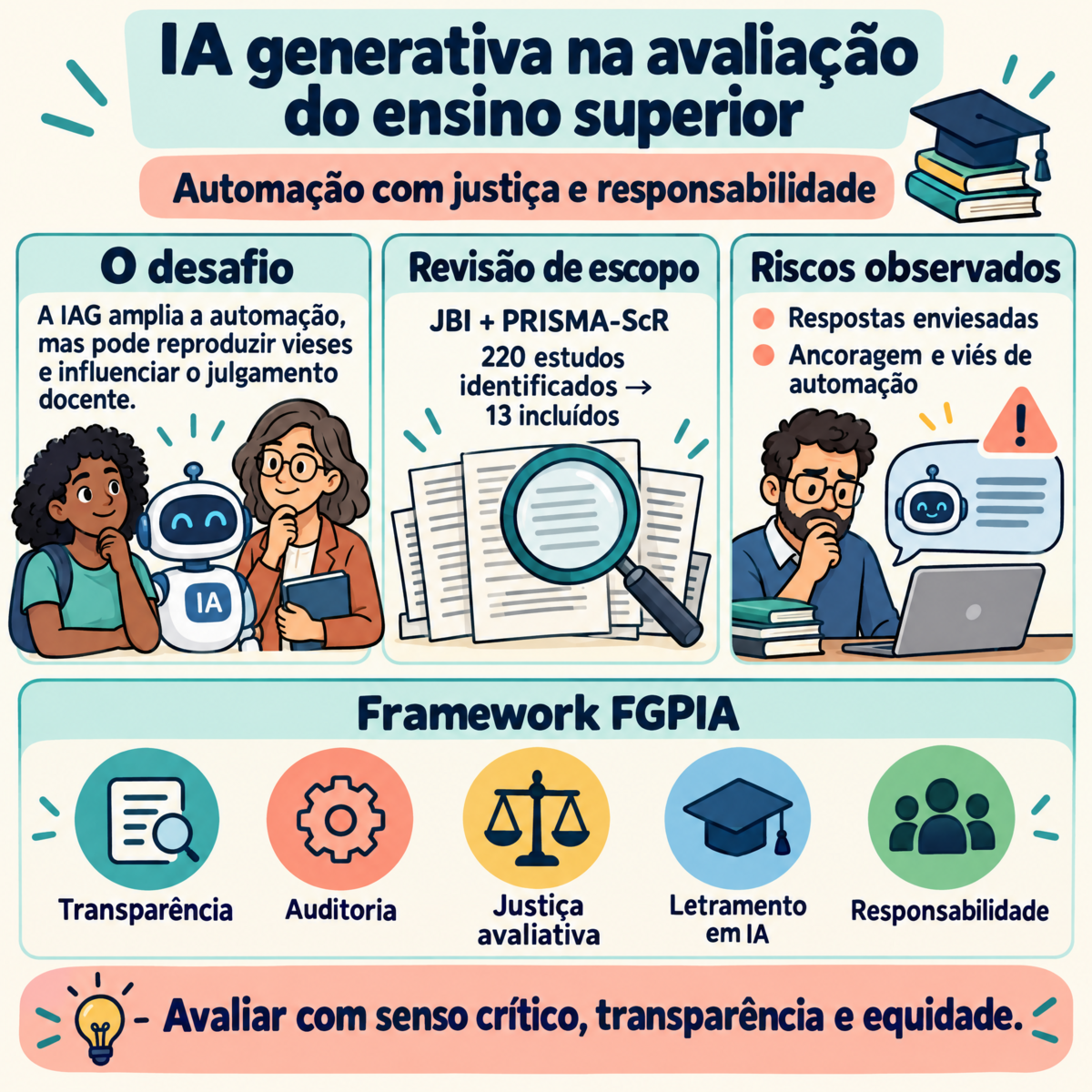
La incorporación de la inteligencia artificial generativa (IAG) en la evaluación en la educación superior amplía las posibilidades de automatización, pero plantea preocupaciones sobre los sesgos algorítmicos y la justicia evaluativa. Este estudio tuvo como objetivo identificar y analizar evidencias sobre los sesgos de la IAG y su influencia en el juicio pedagógico del profesorado, examinando sus implicaciones para la justicia evaluativa y la gobernanza pedagógica. Se realizó una revisión de alcance siguiendo la metodología del Joanna Briggs Institute (JBI) y las directrices PRISMA-ScR. Se efectuaron búsquedas en Scopus, Web of Science, ERIC, ACM Digital Library, Google Scholar y OpenAlex, complementadas con una búsqueda retrospectiva de referencias. De los 220 estudios identificados, 13 se incluyeron en la síntesis. Los resultados indican que la IAG puede generar respuestas sesgadas e influir en las decisiones docentes mediante el sesgo de anclaje y el sesgo de automatización. Como contribución conceptual, se propone el Marco de Gobernanza Pedagógica de la Inteligencia Artificial (MGPIA), basado en la transparencia, la auditoría, la justicia evaluativa, la alfabetización en IA y la responsabilidad, para orientar prácticas evaluativas más críticas, transparentes, responsables y equitativas.
Descargas
Referencias
Alfaleh, M. (2026). Sustainable AI-driven assessment in higher education: A systematic review of fairness, transparency, pedagogical innovation, and governance. Sustainability, 18(2), Article 785. https://doi.org/10.3390/su18020785
Al Mohsen, F. S. (2025). Ethical integration of generative AI in higher education assessments. In A. ElSayary (Ed.), Prompt engineering and generative AI applications for teaching and learning (pp. 275–288). IGI Global. https://doi.org/10.4018/979-8-3693-7332-3.ch017
Aromataris, E., Lockwood, C., Porritt, K., Pilla, B., & Jordan, Z. (Eds.). (2024). JBI manual for evidence synthesis. JBI. https://doi.org/10.46658/JBIMES-24-01
Du, P., Liu, T., & Xian, X. (2026). Automation bias in teachers’ evaluation of student writing: Effects of algorithmic warnings and visual risk cues in AI detection reports. Frontiers in Psychology, 17, Article 1889402. https://doi.org/10.3389/fpsyg.2026.1889402
Goulas, S., Megalokonomou, R., & Sotirakopoulos, P. (2026). Why do experts miss AI’s errors? Evidence from a randomized labeling experiment. PNAS Nexus, 5(6), Article pgag146. https://doi.org/10.1093/pnasnexus/pgag146
Huang, S. (2025). AI in education: A critical review of applications, bias, and equity challenges. Advances in Engineering Technology Research, 15(1), Article 1679. https://doi.org/10.56028/aetr.15.1.1679.2025
Jiao, J., Afroogh, S., Chen, K., Atkinson, D., & Dhurandhar, A. (2024). The global landscape of academic guidelines for generative AI and large language models [Preprint]. arXiv. https://doi.org/10.48550/arXiv.2406.18842
Joanna Briggs Institute. (2020). Template for scoping reviews protocols [Template]. https://jbi.global/scoping-review-network/resources
Karunaratne, T., Aghaee, N., & Ferati, M. (2025). Harnessing the generative AI wave towards fair and diverse higher education assessments: A comprehensive analysis through an innovative lens of students. European Conference on e-Learning, 24(1), 476–484. https://doi.org/10.34190/ecel.24.1.4259
Khlaif, Z. N., Ayyoub, A., Hamamra, B., Bensalem, E., Mitwally, M. A. A., Ayyoub, A., Hattab, M. K., & Shadid, F. (2024). University teachers’ views on the adoption and integration of generative AI tools for student assessment in higher education. Education Sciences, 14(10), Article 1090. https://doi.org/10.3390/educsci14101090
Küçükuncular, A. (2026). Dehumanising education: AI and the capitalist capture of teaching. AI and Ethics, 6, Article 123. https://doi.org/10.1007/s43681-026-01006-5
Liang, W., Yuksekgonul, M., Mao, Y., Wu, E., & Zou, J. (2023). GPT detectors are biased against non-native English writers. Patterns, 4(7), Article 100779. https://doi.org/10.1016/j.patter.2023.100779
Lye, C. Y., & Lim, L. (2024). Generative artificial intelligence in tertiary education: Assessment redesign principles and considerations. Education Sciences, 14(6), Article 569. https://doi.org/10.3390/educsci14060569
Mundim, R. R., Dionisio, D. L., Mena, D. da S., Oliveira, D., & Victer, E. das F. (2025). Evaluation of open-ended responses in education with the help of ChatGPT: Challenges in implementation. Revista de Gestão Social e Ambiental, 19(9), Article e013330. https://doi.org/10.24857/rgsa.v19n9-044
Olaniyan, Y. D., Martins, M. O., & Al Maqrashi, R. H. (2026). Generative artificial intelligence and epistemic (in)justice: Perspectives from higher education students in the Global North and South. Frontiers in Human Dynamics, 8, Article 1790324. https://doi.org/10.3389/fhumd.2026.1790324
Ragolane, M., Patel, S., & Salikram, P. (2024). AI versus human graders: Assessing the role of large language models in higher education. Asian Journal of Education and Social Studies, 50(10), 244–263. https://doi.org/10.9734/ajess/2024/v50i101616
Rosbach, E., Ammeling, J., Ganz, J., Bertram, C. A., Conrad, T., Riener, A., & Aubreville, M. (2026). Stuck on suggestions: Automation bias, the anchoring effect, and the factors that shape them in computational pathology. Machine Learning for Biomedical Imaging, 2026, 126–147. https://doi.org/10.59275/j.melba.2026-87b1
Selvam, M., & González Vallejo, R. (2025). Human-in-the-loop models for ethical AI grading: Combining AI speed with human ethical oversight. EthAIca, 4, Article 413. https://doi.org/10.56294/ai2025413
Tricco, A. C., Lillie, E., Zarin, W., O’Brien, K. K., Colquhoun, H., Levac, D., Moher, D., Peters, M. D. J., Horsley, T., Weeks, L., Hempel, S., Akl, E. A., Chang, C., McGowan, J., Stewart, L., Hartling, L., Aldcroft, A., Wilson, M. G., Garritty, C., . . . Straus, S. E. (2018). PRISMA extension for scoping reviews (PRISMA-ScR): Checklist and explanation. Annals of Internal Medicine, 169(7), 467–473. https://doi.org/10.7326/M18-0850
Tversky, A., & Kahneman, D. (1974). Judgment under uncertainty: Heuristics and biases. Science, 185(4157), 1124–1131. https://doi.org/10.1126/science.185.4157.1124
Wang, X., & Luo, G. (2026). Evaluating racial bias in LLM reasoning: Implications for equitable AI use in education [Preprint]. OSF Preprints. https://doi.org/10.35542/osf.io/ynt3h_v1
Yang, K., Raković, M., Gašević, D., & Chen, G. (2025). Does the prompt-based large language model recognize students’ demographics and introduce bias in essay scoring? [Preprint]. arXiv. https://doi.org/10.48550/arXiv.2504.21330
Zhao, J., Chapman, E., & Sabet, P. G. P. (2024). Generative AI and educational assessments: A systematic review. Education Research and Perspectives, 51, 124–155. https://doi.org/10.70953/ERPv51.2412006